


ON VIEW
08 MAR 08: Vanishing New York
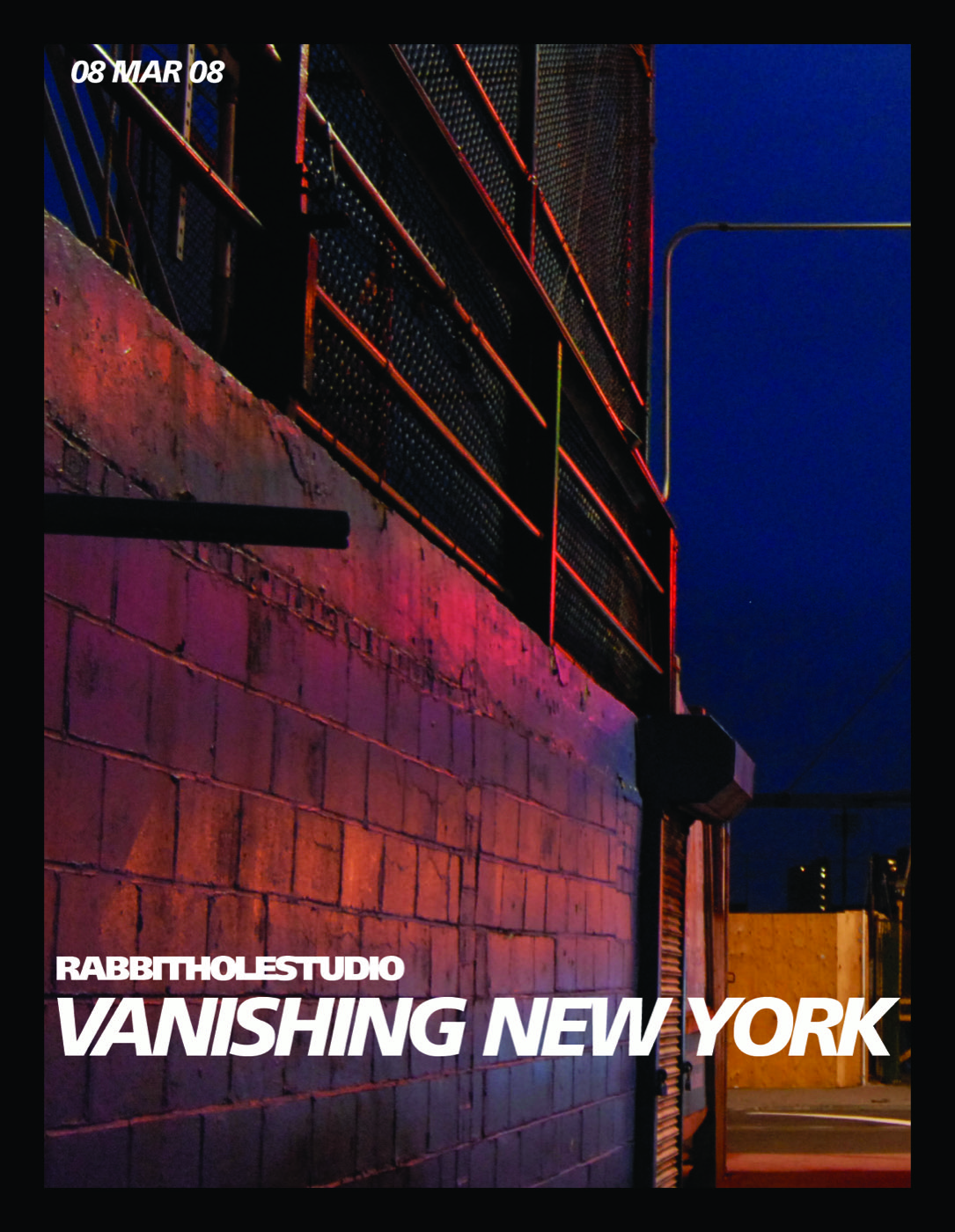
VANISHING NEW YORK
08 MAR - 01 APR
Lana Bortolot
Serge Cashman
Stephen Dirkes and Tal Shpantzer
Christopher Franko
Federico Savini
Lieh Sugai
OPENING RECEPTION 5-9p
SAT 08 MAR 08
Wed-Fri 6-8p and by appointment
While many people have a romantic vision of New York City, the city itself is not a sentimental place. A perpetual flow of new arrivals forces a constant reinvention of what was once familiar: a corner mom and pop store, an entire neighborhood, the waterfront or the skyline. For visual artists who live and work here, interpreting change is an unavoidable challenge. Does transformation signify hope and renewal? Or is it a temporary state between the past and future?
Each of the six artists uses their lens to explore the notion of vanishing—whether it’s a piece of the city under physical threat or the less tangible fleeting of a way of life. Some document specific New York locales at their pivotal moments of change while others question the theoretical implications of photography's ability to capture reality in flux.
Stephen Dirkes & Tal Shpantzer
"Obscure Object part 3" makes the first installation manifestation of previously screened presentations. The installation will feature mounted photo prints and a printed book of images used to create the film. Self-referential media documentation and trans-media distortion are central to the installation. A creative consumption helix is established as film eats photo eats film.
The "Obscure Object" series documents vanishing New York by capturing timeless and iconic locations. In addition to visually referencing the diners, donut shops, streets and restaurants of mid-century 20th New York cinema, the film also serves to document these fast-fading locales.
Serge Cashman
New York City has always appealed to me because of its urban anarchy and chaos. But this has significantly changed over the last decade -- there's currently a wave crashing through the city, washing away the chaos and installing order. From the crest of this wave, however, you can still catch a glimpse of disorder, especially in construction sites where New York City is both vanishing and emerging.
Christopher Franko
After nearly 70 years Empire Roller Rink, the self-proclaimed “Home of Roller Disco,” closed its doors for the final time. During the 1940s and 50s, across from Brooklyn’s Ebbetts Field, Empire was a destination: it was one of the few rinks in the nation that catered to a predominantly African-American clientele and was allegedly the first to employ a modern sound system by using a disc jockey instead of an organist. In the Studio 54 era superstars like Cher and Ben Vereen skated there.
But more recently, this unique space -- part community center, part discotheque, all old-school –- had become home to a tight-knit family of friends and fellow skaters that spanned the make-up and diversity of the city itself. While I spent over two years of Tuesday nights with these “grown folk skaters”, the images here, a bittersweet series of portraits and candids, were taken during the rink’s final nights. They were all captured on film using Holgas or vintage cameras to capture the vibrant, timeless spirit of the skaters who often joked: “because we move counterclockwise around the rink, skating keeps us young”.
Federico Savini
For a photographer, vanishing is a difficult word to love considering that the act of photographing is about mechanically capturing reality with its vertiginous amount of detail. Vanishing can be as terrifying as fading, and more the result of an accident than a voluntary act.
But the photographic process, as mechanical as it is, is ambivalent and subjective enough to be able to embrace the concept of vanishing in all its forms, physical to philosophical, to escape that cold perception of objectivity that an image with all its possible detail has.
Vanishing, like changing, dying, being reborn, moving…..vanishing as part of a process were reality hasn’t been stopped completely, a reality that is never fully captured, where time and space exist like in our lives.
Lieh Sugai
I first became fascinated with Coney Island through movies and fashion magazines when I was in Japan. The first thing I did when I arrived in New York in 1997 was visit Coney Island, even though it was winter. From gentle boardwalk breezes in summer to the chilly silent beach in winter, I've lost track of how many times I returned. It's become my life's work to photograph Coney Island and its people.
These 25 new color photographs are the next phase of my infatuation. And combining them with the images from my 2005 exhibition "Finding Neptune -Coney Island" this is a collage of my Coney Island memories from the past 10 years.
25 JAN 08: Frank Lentini, Tim Lynch, Ian Umlauf

FRANK LENTINI, TIM LYNCH, IAN UMLAUF
25 JAN - 17 FEB 08
Opening reception Fri 25 JAN 08. 7:00 - 9:00 pm
Rabbithole studio presents current works by Brooklyn artists Frank Lentini, Tim Lynch, and Ian Umlauf. Each artist presents his own formal approach to making art in a contemporary environment.
Tim Lynch stages work that may seem abrasive or aggressive alongside pieces that are more subtle and sensitive in nature. In doing so and by using a variety of subject matter, materials, and textures he attempts to create a delicate and perhaps at times indiscernible relationship between the two. He challenges the viewer to reflect on whether a dichotomy of images such as the ones he presents us with can co-exist in one space together.
Frank Lentini takes a traditional approach to painting while he employs his personal form of action painting. Lentini uses a brush, his hand, sanding or pouring to create rich, textured surfaces. His focus is on a balance between decision making and a spontaneous, unpredictable layering process.
Ian Umlauf uses anonymous, found photographs to create relationships that are often formal and thematic. In the resulting spaces, bodies are doubled, interiors and exteriors are conflated, and a myriad of surfaces become points of contemplation. Umlauf's collages heighten the viewer's self-awareness through the interplay of these visual conundrums.
Frank Lentini received a MFA degree from Pratt Institute. Tim Lynch received a BFA degree from the School of Visual Arts. Ian Umlauf received a MFA degree from Hunter College.
15 NOV 07: ATIXIP: TE FOXL by Jason Gandy
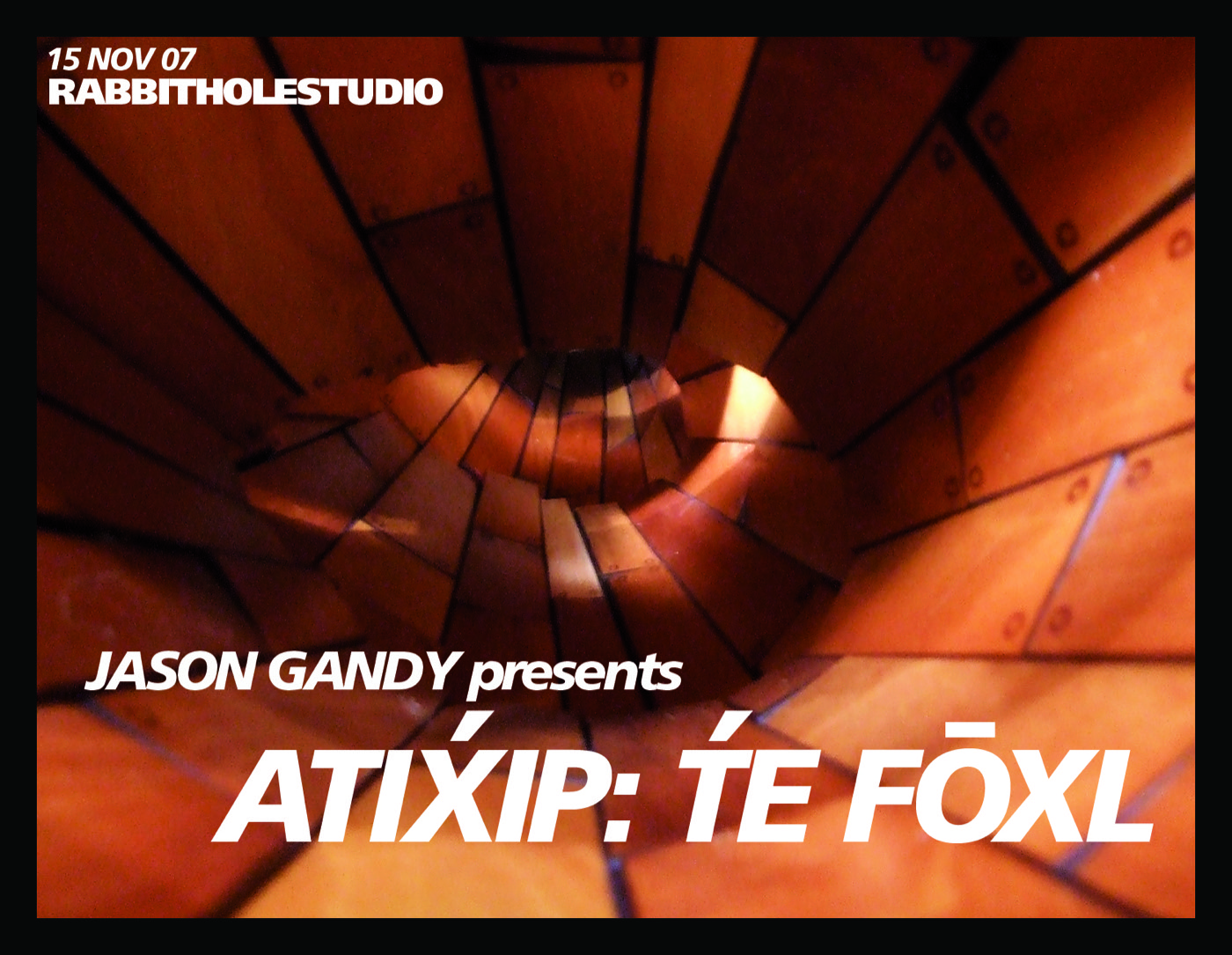
ATIXIP: TE FOXL by Jason Gandy
November 15, 2007 – January 17, 2008
Opening reception Thursday, November 15, 7 – 9p
Closing reception Saturday, January 12, 7 – 9p
Rabbithole Studio is pleased to present ATIXIP: TE FOXL, a seminal work from New York born artist, Jason Gandy. Wetting our palettes, this exhibition is the first of a series and introduces us to an ostensibly private, if not secret, story. Characters and environments, well defined and three-dimensional, are thrust upon the viewer only to leave us grasping at who, what and where they are. These highly designed forms of predominantly wood and leather are impressions - refracted reflections - of a story Gandy is inviting us – luring us – to witness. It’s a story of ethereal ships, armored ghosts and mythic creatures. This is a show of vessels, some empty and wanting, some full and searching, but all somehow alive and all apparently unaware of or disinterested in us, their audience.
The Caravaggian lighting supports any presumption that these forms are from a darkness, from the unknown, from a place we are not privy to. ‘Atixipman’ [read ‘Attic-ship-man’] seems to beckon us from our well-lit entryway into his shadows. This piece resembles a life-size, fully articulated suit of armor crafted with thousands of individually shaped pieces of bamboo, oak and maple. Gandy, an expert craftsman, has molded each piece of wood to contour the body of its missing host. Completing the suit is a mask with a crudely carved and primitive visage. Yet despite the armor and the rugged mask, a gentle delicacy is attained through its pose, kneeling on one knee and gently reaching out.
‘Te Foxl w/Skroo-I’ [The Fo'c'sle with Screw-eye] resembles the stern of a boat emerging through the gallery wall. Worn pulley blocks serve as steps for the viewer to look into a warmly lit porthole. Through the porthole, the viewer sees an approximation of the full length of a ship from stern to bow, what would seem a distance of some 40’, though the gallery wall is only two feet distant from the porthole.
Bearing sharp reference to Duchamp and Brunelleschi, ‘Gohnisip’ [Gohni ship] is a small ship with a tiny porthole. Aside from the careful craftsmanship of this gilded ship, we notice nothing remarkable until we look through the porthole. There, inside the ship, we see a tiny human-like creature though furry and with horns. He seems to be deliberately stitching something and not paying mind to much else.
Bringing texture to this world, are an assortment of ‘Trees’ which seem to be an industrialized revision of the bonsai, full of corners and hard lines yet preserving the organic gestures of bonsai branches.
Gandy’s work nudges the viewer to become the privileged outsider, the peeping Tom, thrilled to see what shouldn’t be seen, thrilled to see without being seen. We take for granted that Gandy has some authority here, and so we look without shame. We look instead, for a moment at least, with a hint, or more, of childlike elation, with that wonder that spins us silly when we witness the impossible.
Jason Gandy was born and raised on Roosevelt Island in New York City. He received his BFA from Tyler School of Art in Philadelphia. He has most recently exhibited work in a group show with the Dean Street Collective.