


OUR STORY
Watch the film
Rabbithole, a short film (7 minutes). Narrated by Shawn Lyons. Music: “So long, Seymour” by Emanuel Smith, with Sean Lewis and Justin Holley. Videos by Ana Maria Camejo and Caroline Pham.
THE BASEMENT
Before any of this, I had a dream. I was walking down a block in DUMBO at night, just after a light rain. The cobblestones were wet, an old street lamp was lit, and I had a feeling I'd be spending a lot of time there.
At the time, I was running a young moving company from a desk in my bedroom, in an apartment in South Park Slope that I shared with Jason Gandy. We'd met in college, where Jason was a student at Tyler School of Art. I was studying literature and writing on the main campus, but I lived in the Tyler dorms, to be around artists.
Teodora Koleva, a dancer, moved in as a roommate, and before long we were together, and working side by side at that one desk. It was Teodora who found us our first real office: a small corner room at Washington and Plymouth Streets in DUMBO, with a view of the river under the Manhattan Bridge.
Down the street, in the basement of 33 Washington, three painters, Chris Dasilva, Ben Marxen, and Jin Meyerson, had built out a warren of studios. In 2003, Rabbit Movers was hired to move a tenant out of one of them. Our friend Javier Martinez, a sculptor who worked in metal, was on that job. He asked Ben, Chris, and Jin about the empty studio, took it, and invited Jason to share it. Next door was Andrea, a set and prop designer, whom Jason already knew; both had worked for the furniture maker David Barthes. After a few months, Javier moved on. Then, in November 2004, a big storm flooded the basement. Floors were soaked and work was damaged, and Jason and Andrea left to set up a workshop together. Teodora and I took over Andrea's studio to store moving equipment. It was a single room with a concrete floor.
It didn't stay a storage room for long.
WARREN SPACE
We called it Warren Space, after a rabbit warren: a home hidden underground, which is exactly what it was. Our logo was a pair of rabbit ears diving into a hole. Almost nobody got the reference, but we loved it.
To afford the space, Teodora and I moved in. The room was about thirty-two feet by nineteen, with the door in one corner. Twelve feet in, a three-quarter wall and a tall folding divider closed off the moving company's office, along with a fold-out couch, a chair, and a piano. Visitors walked through a short passage beside the divider and into the gallery: a nineteen-foot square of bare walls and concrete floor.
Our first exhibition opened on April 2, 2005. My friend Andrian Phillips curated it, with his friends Erin Rae Lengkeek and Daelyn Short among the artists, and they helped us turn that room into a gallery, working out the lighting and painting everything in time for opening night.
That June, Teodora had an idea: to stage a dance performance right there. She curated The Annunciation of Venuses, an evening of dance and music, and performed a piece of her own. There were no chairs. The dancers performed in the nineteen-foot-square room, on bare concrete. Teodora and I were both so moved that night. It was clear the room had to become something more.
That October, during the DUMBO Arts Festival, we opened our second show, Seahorse / Exploring Memory's House, curated by Teodora, with new work by Merav Ezer, Yoram Porath, and Teodora herself. The title came from the hippocampus, the part of the brain that holds memory, whose name means "seahorse." A poster with an arrow pointed visitors downstairs.
In time, Teodora found an apartment of her own and moved on to other work, and in 2006 I moved onto a sailboat on the Gowanus. But the room she first imagined as a stage had become a gallery, and there was no going back.
RABBITHOLE STUDIO
I'd known Justin William Lin, a little, for years. In the days after 9/11, I had started driving west for a squid fishing job, got as far as Ohio, and turned around to be closer to New York. I didn't know where to go, so I went to an apartment in the East Village where my friend Carlos Vidal was staying with friends. Justin was one of them. I gave him a ride to the airport when he left for school in Scotland, and our paths kept crossing after that. Around 2005, he moved into the studio next to ours, the one Javier and Jason had shared, and his arrival changed everything.
People never did get the Warren reference. Galleries are so often named after their owners that most assumed Warren was some guy's name. So in 2006, Justin and I put it in plain English: Rabbithole.
One of the painters who had built the basement moved out, and the others agreed to let us expand. We knocked a doorway through a wall into the back room, and suddenly there was room for a photo studio alongside the gallery. We laid a half-sprung oak floor ourselves, on rubber squares beneath the joists, on advice from the people who had floored Dance New Amsterdam, then whitewashed and sealed it. Dance New Amsterdam gave us a wall of mirrors, and we hung a full light grid and a projector for shoots and performances. Everything was white. That white room was Rabbithole.
Justin, a photographer and designer, gave it its look: the logo, the website, and most of the exhibition postcards for years to come. His own series, Couples, launched the new Rabbithole in October 2006, opening during the DUMBO Art Under the Bridge Festival with a weekend of video, performance, bands, and dance, and later traveled to Seoul. At the bottom of the program, we thanked all the Rabbits of Rabbit Movers for making it possible, because they had.
Over the next few years, the shows came one after another. Jason Gandy returned with ATIXIP, his first solo show: a wooden suit of armor, a ship's stern breaking through the gallery wall, and a tiny horned creature glimpsed through a porthole, played live at the closing by the dancer Juliette Morel. There were open calls for emerging artists, which Justin and I selected together, shows from Brazil and South Africa, and in 2009, Patti Smith's Fridge, a group show by the movers themselves, who voted on the title because they had just moved Patti Smith's fridge.
ART ATTACKS
Rabbit Movers was a collective of its own: movers who were painters, musicians, dancers, actors, and writers. When people asked how artists could lift anything, I'd say there were plenty who couldn't lift a couch. "We find the ones that can." So it made sense that the trucks would become part of the art, too.
We called them Art Attacks: pop-up exhibitions inside our moving trucks. We'd line the inside of a truck with white walls, hang track lighting, set proper steps up to the back, and park it wherever the art needed to be seen, at open studios, art walks, and festivals across Brooklyn. Artists paid a small fee to use a truck, and the movers helped set everything up. One year, during Bushwick Open Studios, two trucks joined back to back became a gallery for Matt Witmer's photographs and poems.
The first Art Attack came together in the summer of 2009, when a New York Times reporter came to write about us. The photo that ran with the story showed Color War playing in the back of one of our trucks. For a couple of years, the trucks were galleries almost as often as they were moving trucks. After Sandy they came out less often, but they kept appearing, now and then, until the end.
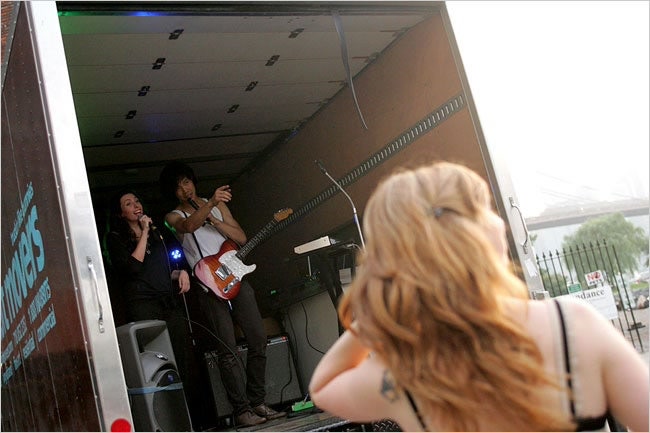 The first Art Attack, August 2009: Color War (Lindsay Mound and Justin William Lin) in the back of a Rabbit Movers truck, with Erica Harmon watching. Photo: Jessica Ebelhar / The New York Times
RABBITHOLE
In October 2011, the painters who had built the basement moved on, and I took over the whole space. By then, Rabbithole had become much more than a gallery. The sign out front simply said RABBITHOLE and listed everything inside: the gallery and photo studio; Sono Osato's painting studio; Marilu Villanueva's jewelry and metalwork studio, Malula Jewelry; Creatively Wild, Donna-Maree Wilding's art school for children, which began with a student or two and grew quickly; Brooklyn Central, Justin's school for photography and creative skills; Siobhan Towey's massage practice, NYC Massage and Healing (now DUMBO Wellness); artist studios in the back; and, from 2012, Rabbit Vinyasa Yoga, classes by donation every day of the week.
There were monthly Movie Nights curated by Caroline Pham, with art-house films and live music; Rabbit Tales, the salon of readings and performance curated by Kate Hill Cantrill, who also helped run the gallery's administration; and The Hare Club, a monthly night of performance created by Siobhan Towey and Lisa Clair. Nyahzul, Kate, Erica Harmon, Cassady Fernandez, Caitlin McGarry, and others kept the shows running, hanging work, painting walls, handling the endless small details, and curating shows, concerts, and performances of their own. You can still walk through it, in Ana Maria Camejo's virtual tour.
And there was Maya, the Rabbithole cat. She was with us from the very beginning, and every day she made her rounds of the building, visiting everyone in their studios: Sono Osato, Dean Russo, Nu Ryu and her studio-mate, Yuriko Katori, Justin, Siobhan, Marilu, the Rabbit Movers office, and me. She wandered through every show in the gallery, and at night she followed Mary from room to room while she cleaned. She liked to curl up on a chair in Dean’s studio, and Dean painted her portrait, Vintage Maya. In 2012 we made a little film of her, Maya in “Run Rabbit Run,” climbing a ladder and strutting along a catwalk built for her, in a pair of rabbit ears. Maya died in August 2013. It was a little lonesome without her.
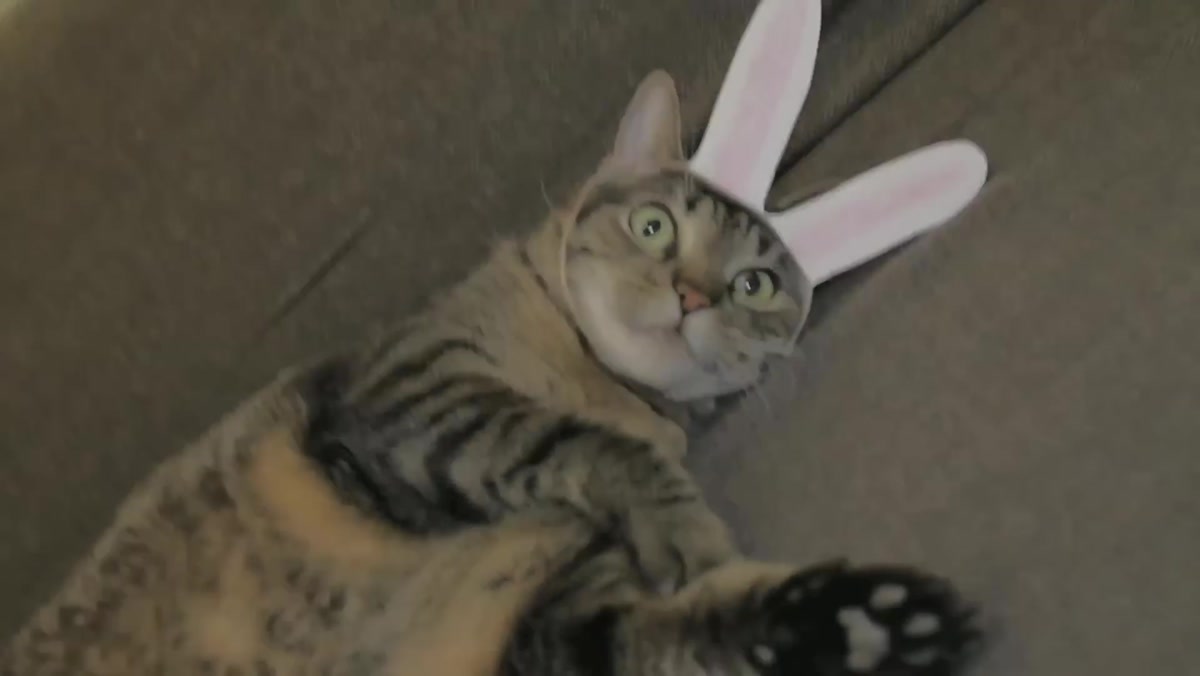 Maya in “Run Rabbit Run”, 2012
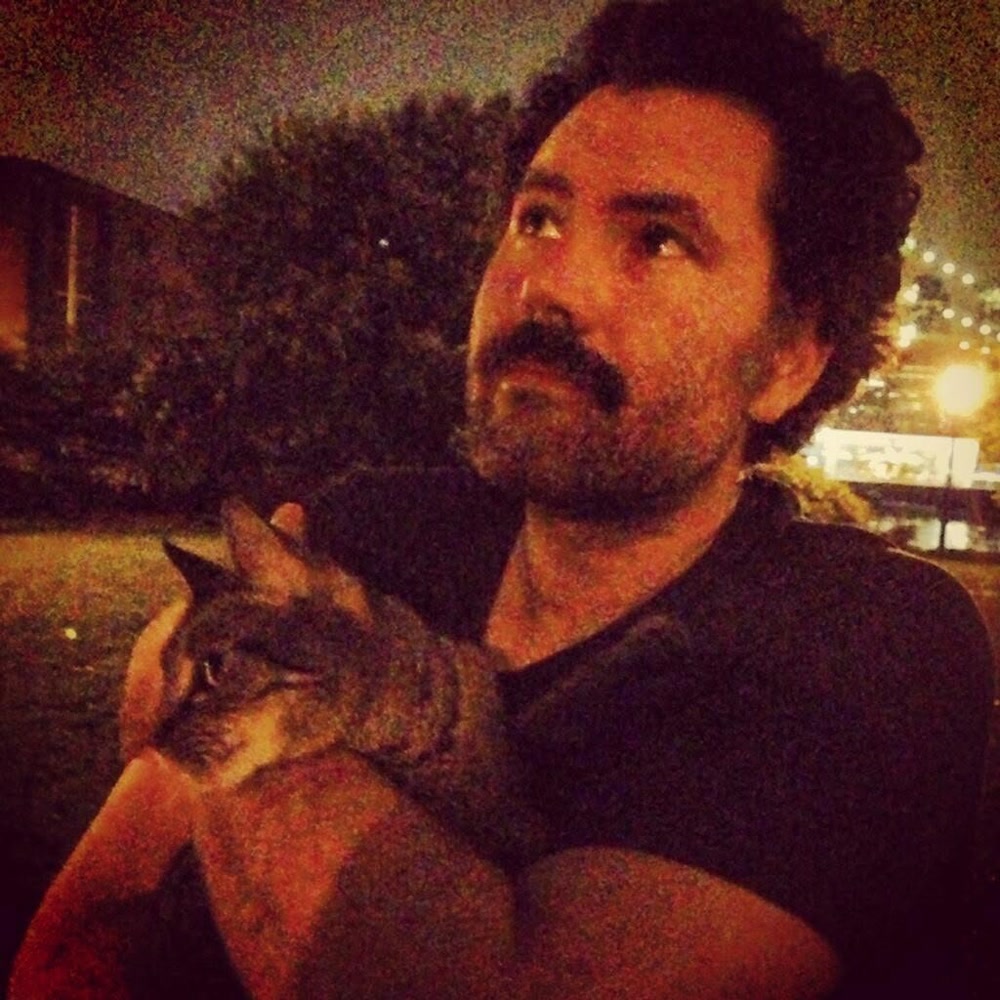 Maya and me, DUMBO, 2013. Photo: Kali Thiru
In the spring of 2012, Brooklyn Independent Television came to film us. Looking back, that was the high point: everything I had imagined, all under one roof.
That October, Hurricane Sandy flooded the basement, and over in Gowanus, where our moving trucks were parked, the storm surge destroyed them all. The community rallied. In March 2013, Sono led a benefit and silent auction during Armory Week, with work donated by more than thirty artists, music, and a room full of friends. That year, Ana Maria Camejo joined us, bringing new energy to how we shared our shows with the world, including lookback videos of many of our exhibitions.
THE FINAL YEAR
In 2013, I moved back into one of the studios. For the last few years, Rabbithole was home again, as it had been at the very beginning.
Rabbithole was always a labor of love, and it lived on the help and goodwill of a small community. We never had a network of collectors or a marketing budget, and I often felt we fell short of what artists hoped a gallery could do for them, especially in finding buyers for their work. Sometimes I called it a community art space rather than a gallery, because that felt more honest. In truth, it was something in between.
By 2015, I was thinking about how a gallery might work differently. Most galleries take a large share of every sale and can show only a handful of artists a year. We set out to do the opposite: show as many artists as possible, and let them keep everything they earned. So we set a goal of 100 exhibitions in twelve months, and made each one a single night. Artists paid a flat fee of $100 toward setup and staffing, and kept every cent of their sales. The hope was to become a nonprofit one day, so that artists would pay nothing at all. Until then, the gallery made up the difference. We called it our year of One Night Stands.
We made it. Painters, photographers, musicians, dancers, and poets filled the room, sometimes several nights a week.
The five-year lease on the basement ran through September 2016. I think I sensed it was ending, and in a way, those hundred shows were our farewell: a year of opening the door as wide as it would go. At the end of that summer, after nearly twelve years, I closed it and left. There was no party, no last night to mark it. I was exhausted, and I regret that we never said goodbye properly.
This archive is my way of saying it now.
AFTERWARD
In the fall of 2019, three years after closing, I put on one more show under the Rabbithole name: a pop-up for Gowanus Open Studios at 426 President Street, called Artists/Work. It was about the jobs artists hold to keep making their work, the waiting tables and temping and moving furniture, which had been at the heart of Rabbithole from the start. When I sent out the call, the list of names went all the way back to the beginning: Teodora, Justin, Jason, Nyahzul, Carlos, and many more. It turned out to be our last show.
It was a farewell to Rabbit Movers, too. For my health, I had decided to sell the company, and in May 2020 I did, to Hugo Tomic, who believed in what Rabbit Movers stood for and was excited to carry it forward. Everyone kept their jobs through the transition. Then I left New York. Sadly, Hugo died a year later. The company passed to other owners, and I've had no connection with it since.
Rabbithole was never mine alone. It belonged to Teodora, who first imagined a stage in a storage room; to Justin, who gave it its look; to Nyahzul, Kate, Erica, Caitlin, Caroline, Cassady, Ana, Sono, Siobhan, Marilu, Juliette, Carlos, and everyone who hung a show, painted a wall, poured a drink, or stayed late to sweep up; to the Rabbits of Rabbit Movers, whose work kept the lights on; and to the more than a thousand artists who showed their work in that basement, many of them for the first time.
Thank you.
If you were part of it, as an artist, a visitor, or a friend, I'd love to hear from you. Share a memory, a photo, or a story, and help fill in what the archive is still missing.
In memory of Javier Martinez, who opened the first door.
- Shawn Lyons
Ephemera
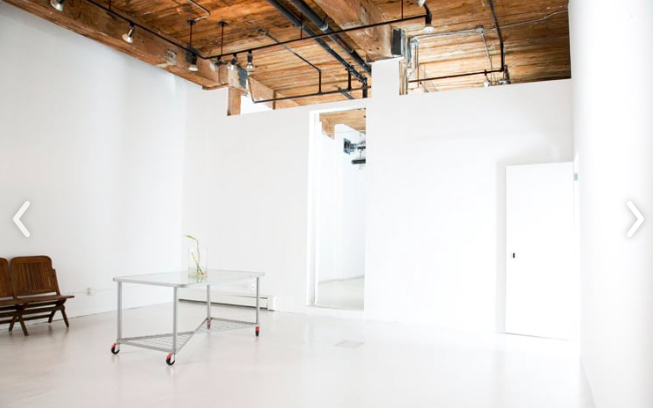
Photo of the gallery space — 2006. Photo by Justin William Lin. Cleaned copy (straightened, cropped and evened out; nothing redrawn) — original photo.
See also: Timeline · Warren Space · Rabbithole Studio, 2006–2012 · Virtual tour of Rabbithole · 2016